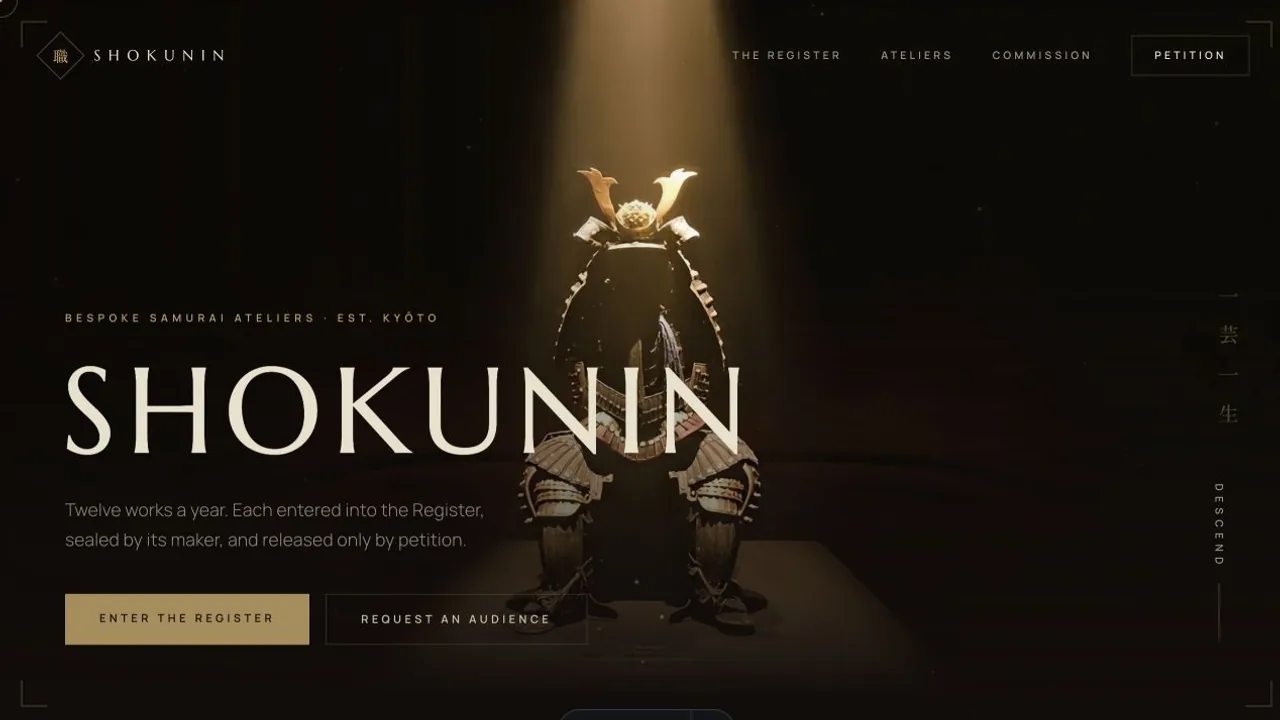
Foundry Series · Self-initiated concept
Shokunin
We do not sell armor. We release it.
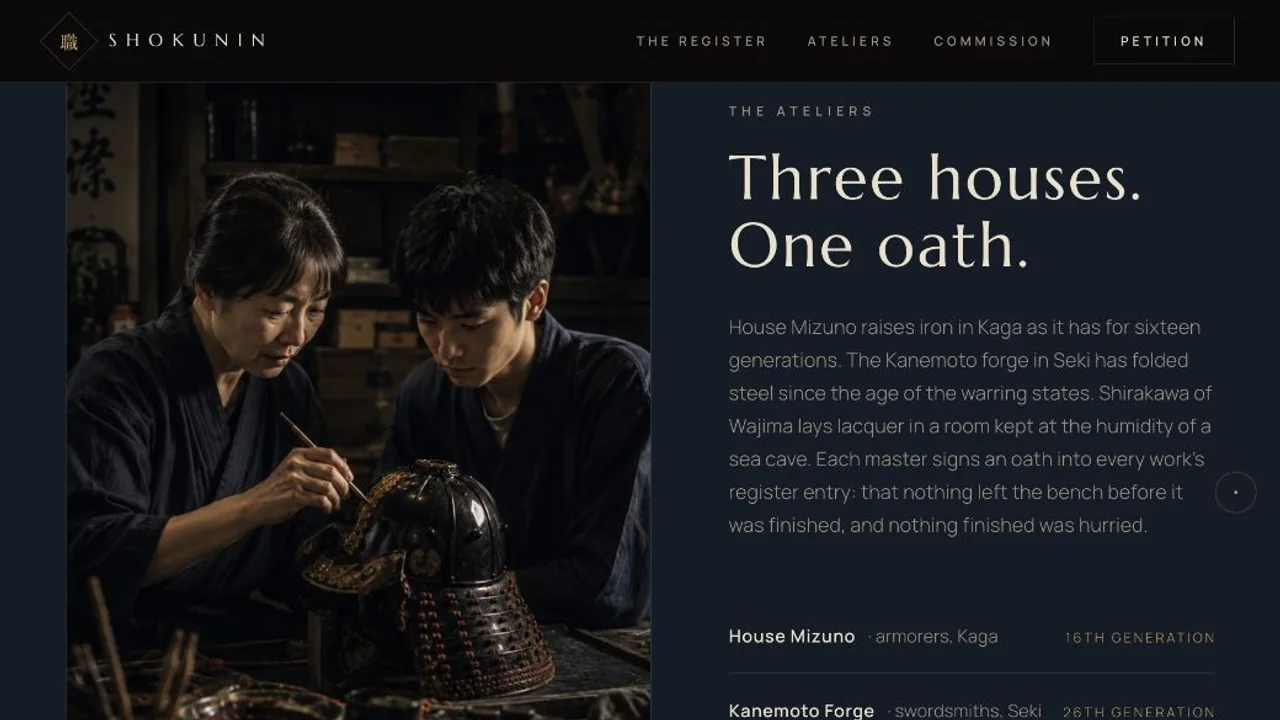
Shokunin is a house uniting three specialist samurai ateliers. It asks how a digital experience changes when the work is scarce, acquisition begins with a petition, and provenance matters more than conventional commerce.
The premise
Turn scarcity into structure.
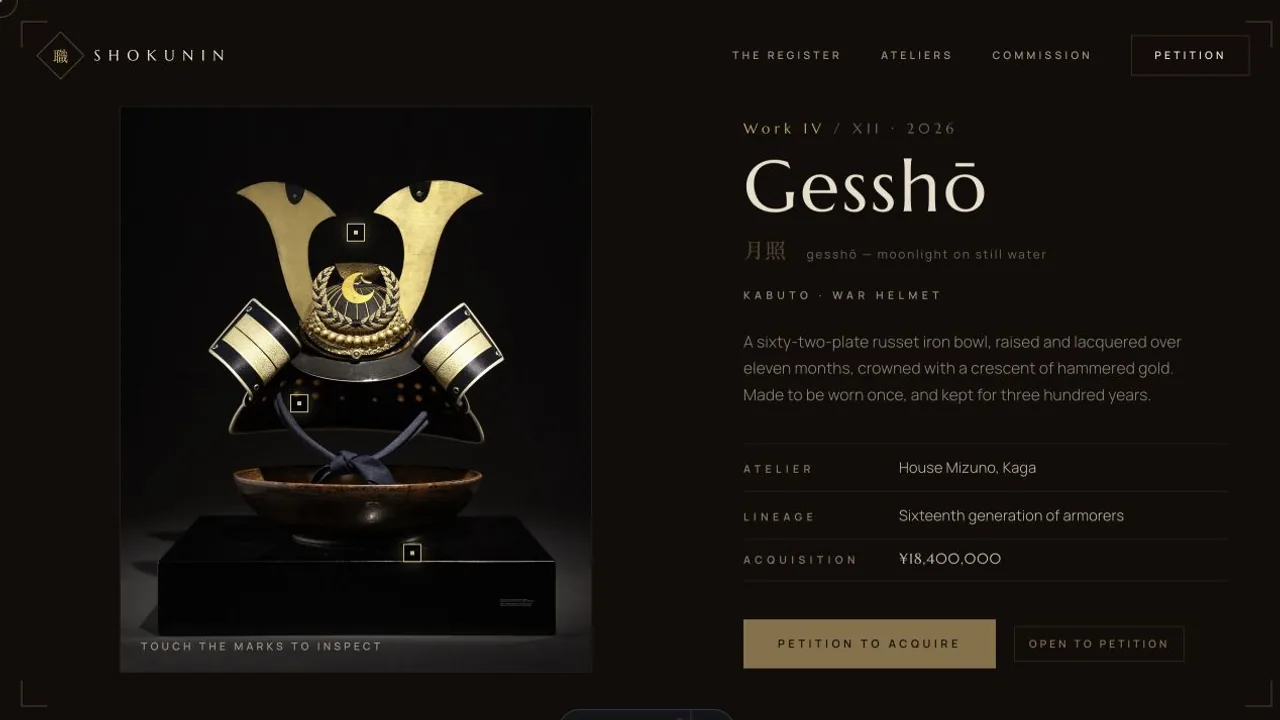
A normal storefront optimizes for breadth, speed, and conversion. Shokunin deliberately refuses that model: twelve works form the annual Register, each belongs to a named atelier, and availability is expressed as Open to petition, Under petition, or Sealed.
The interface behaves like a private commission house because its language, information architecture, and interactions all follow the same fiction. There is no catalog dump, cart, countdown, or manufactured urgency.
Product principles
The world becomes a working system.
The Register, not a catalog
A finite annual ledger replaces endless inventory. Sealed work remains visible, making scarcity and continuity part of the story instead of hiding unavailable objects.
Petition, not checkout
Collectors begin with correspondence. The vocabulary changes the relationship from transaction to consideration while still giving the user a clear path forward.
Provenance as product data
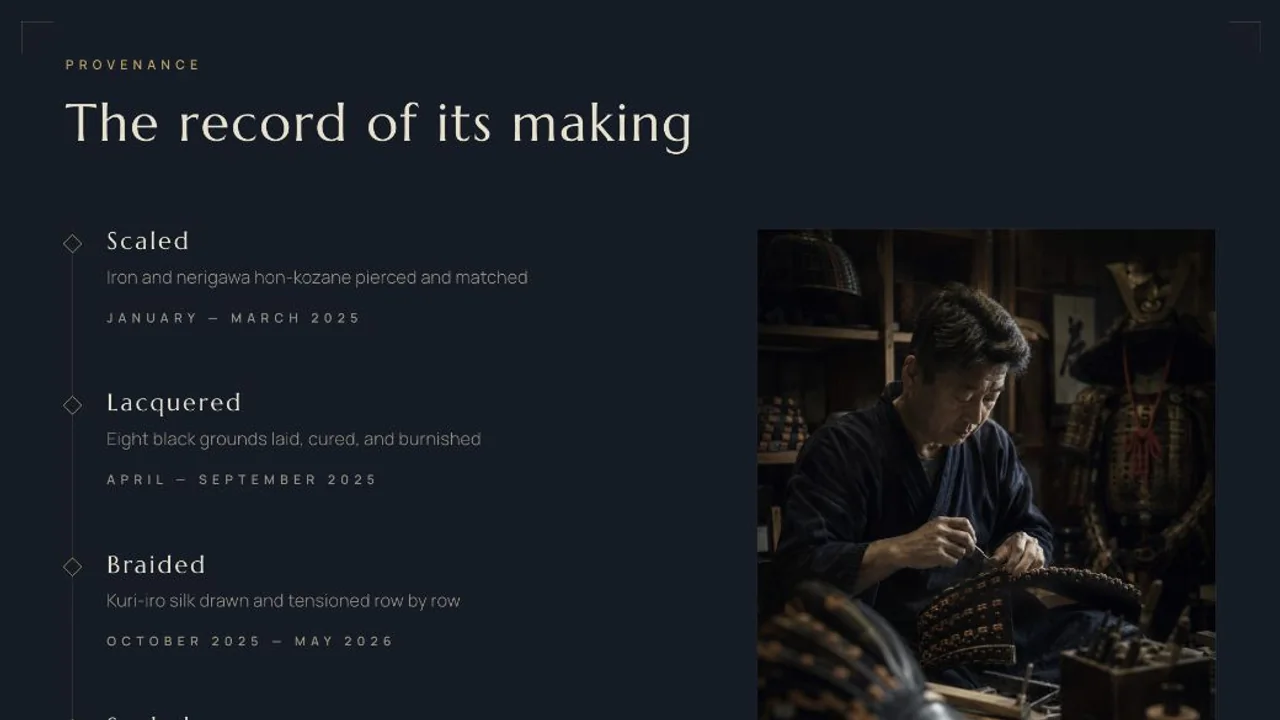
Atelier, lineage, material, craft stages, dates, and maker testimony travel with each work. The dossier makes the record of making as important as the finished artifact.
Built proof
A concept carried into code.
Worldbuilding · Product strategy · Frontend
- Framework
- Astro static site
- Domain model
- Typed works, ateliers, states, and provenance
- Composition
- Curated register + dynamic dossier routes
- Interaction
- Petition flow, hotspots, scroll chapters, reduced-motion support
- Responsive intent
- Asymmetric curation on wide screens; text-led sequence on phones