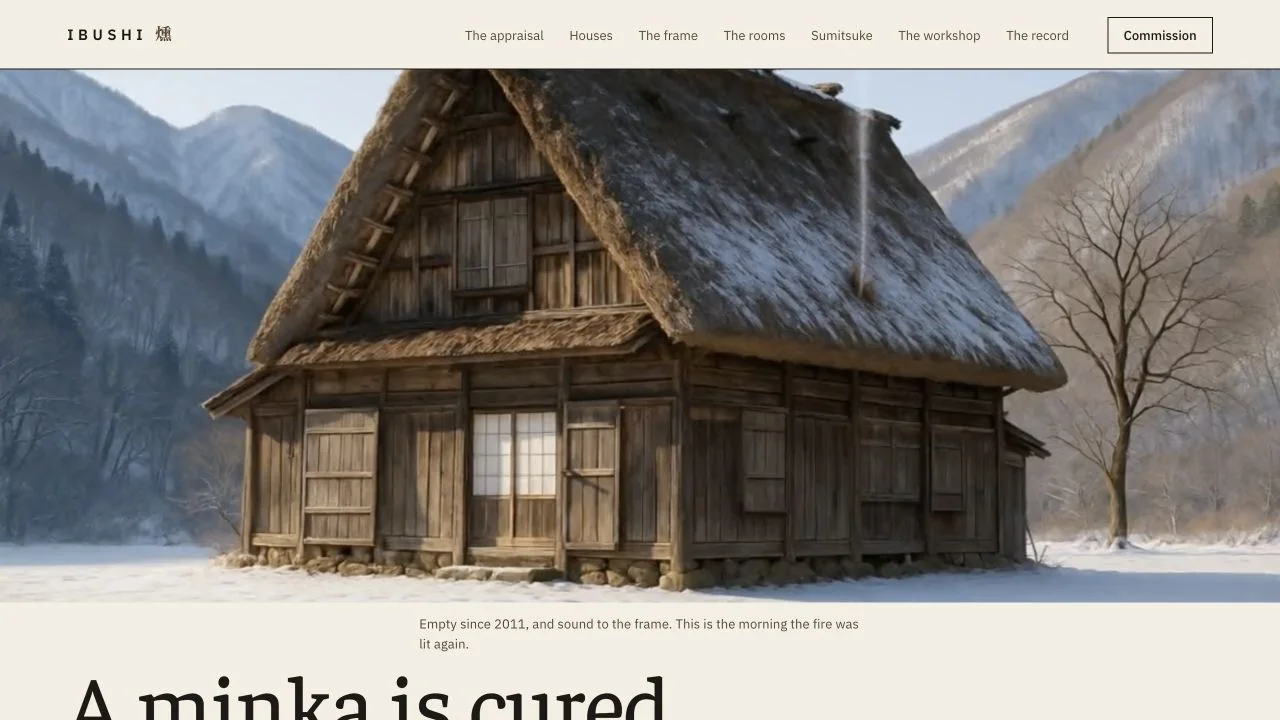
Foundry Series · Self-initiated concept
Ibushi
Forty houses considered. Four accepted. One fire kept alive.
Ibushi translates kominka preservation into an explicit decision system: appraise the frame, define what can endure, adapt typology to climate, and record every intervention.
The premise
Preservation begins with the houses you refuse.
Japan has millions of empty houses, but skilled preservation capacity is finite. Ibushi begins with selection: an explicit appraisal that determines whether a minka can be restored without turning its history into scenery.
The concept treats continued habitation as part of the building system. Smoke, repair, climate, and use are not atmosphere around the house; they are the forces that keep it alive.
Product principles
The world becomes a working system.
Appraisal is a gate
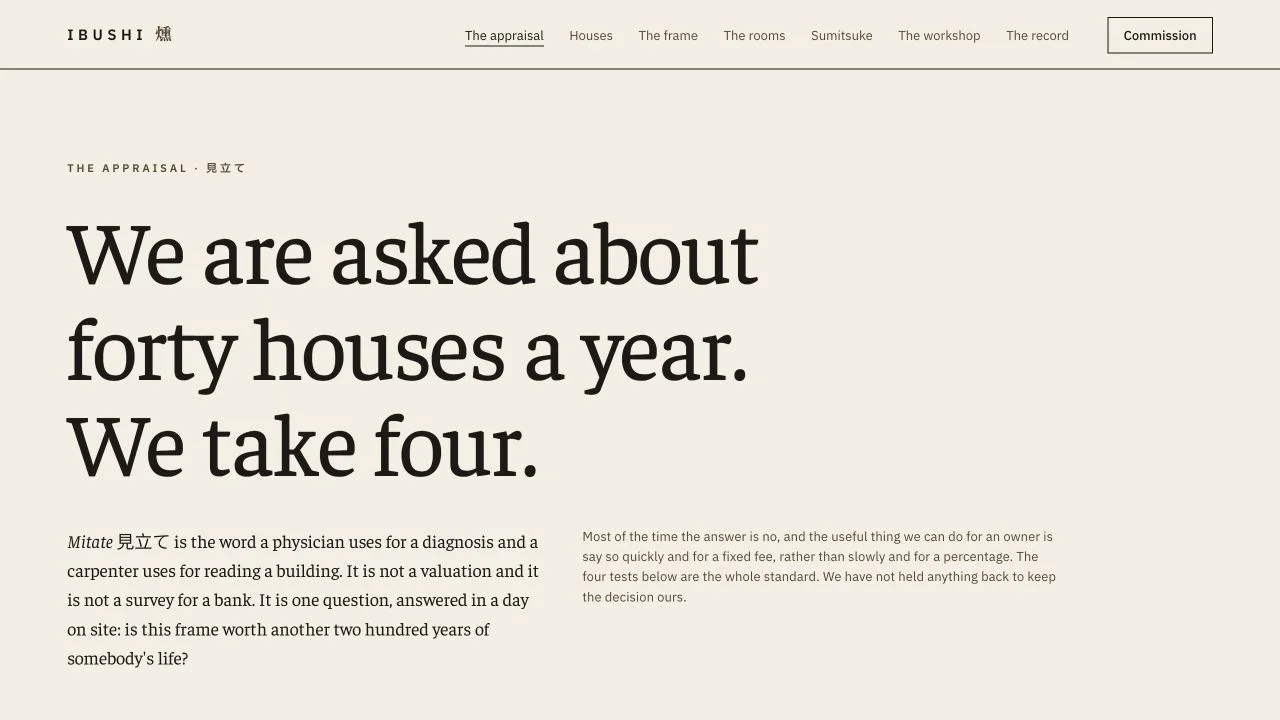
Mitate makes judgment explicit.
Four tests—frame, main pillar, roof, and future habitation—turn specialist intuition into a visible acceptance system. Saying no protects the capacity to do the accepted work well.
Use is preservation
The fire remains part of the structure.
Ibushi frames smoke and habitation as maintenance: the house survives because somebody continues to live in it, light the hearth, and renew its protective layer.
Typology is constraint
Climate and form become working rules.
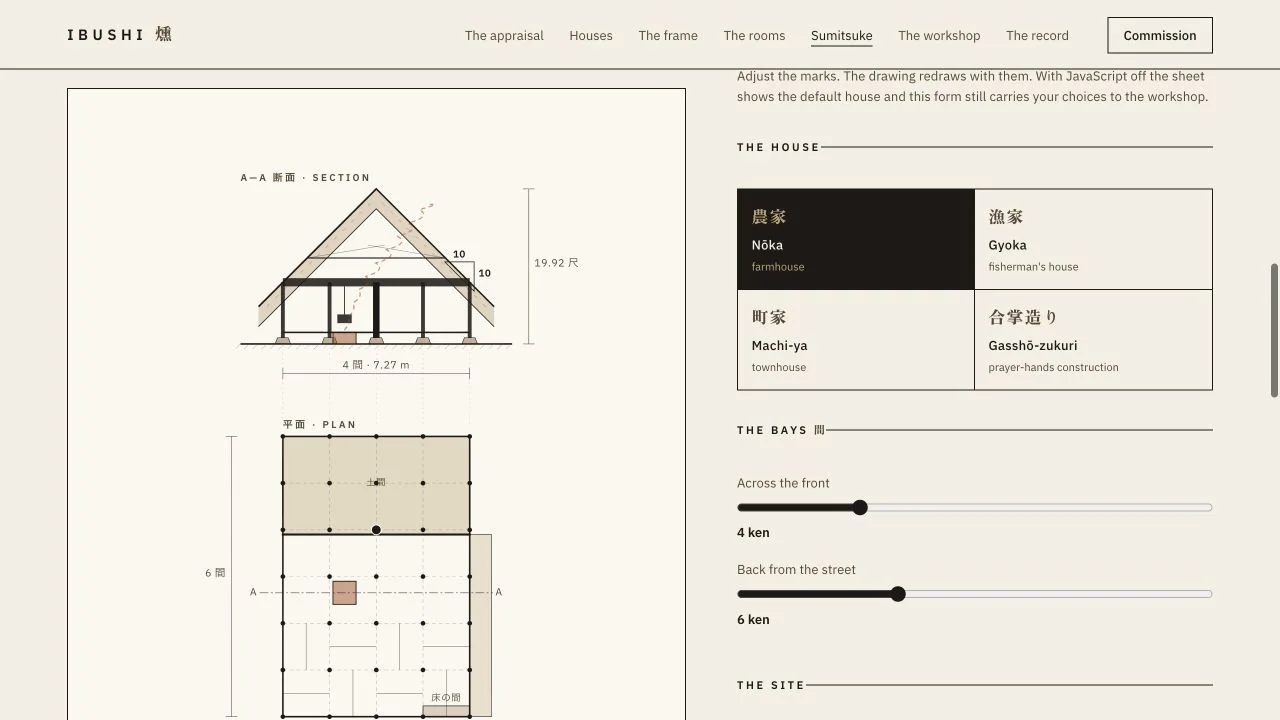
Nōka, gyoka, machi-ya, and gasshō-zukuri are treated as different systems. Bay module, roof, earth floor, and climate guide the intervention instead of yielding to one generic template.
Built proof
A concept carried into code.
Systems thinking · Art direction · Product model · Frontend
- Mitate
- A four-part appraisal makes acceptance criteria legible before restoration begins.
- Sumitsuke
- A live plan and section respond to house type, bay module, climate, and earth-floor share.
- Typology
- Four minka families preserve the consequences of place rather than flattening them into one style.
- Munafuda
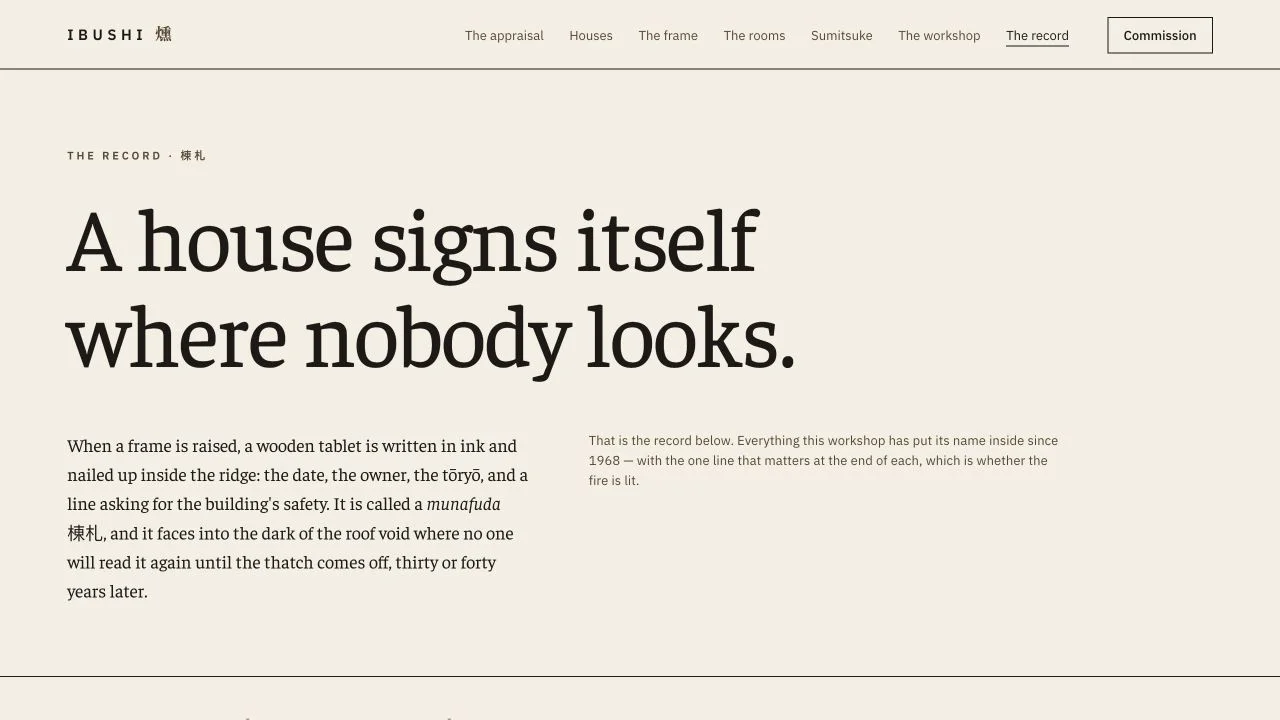
- An intervention record connects frame, work performed, hearth state, and workshop history.