Foundry Series · Self-initiated concept
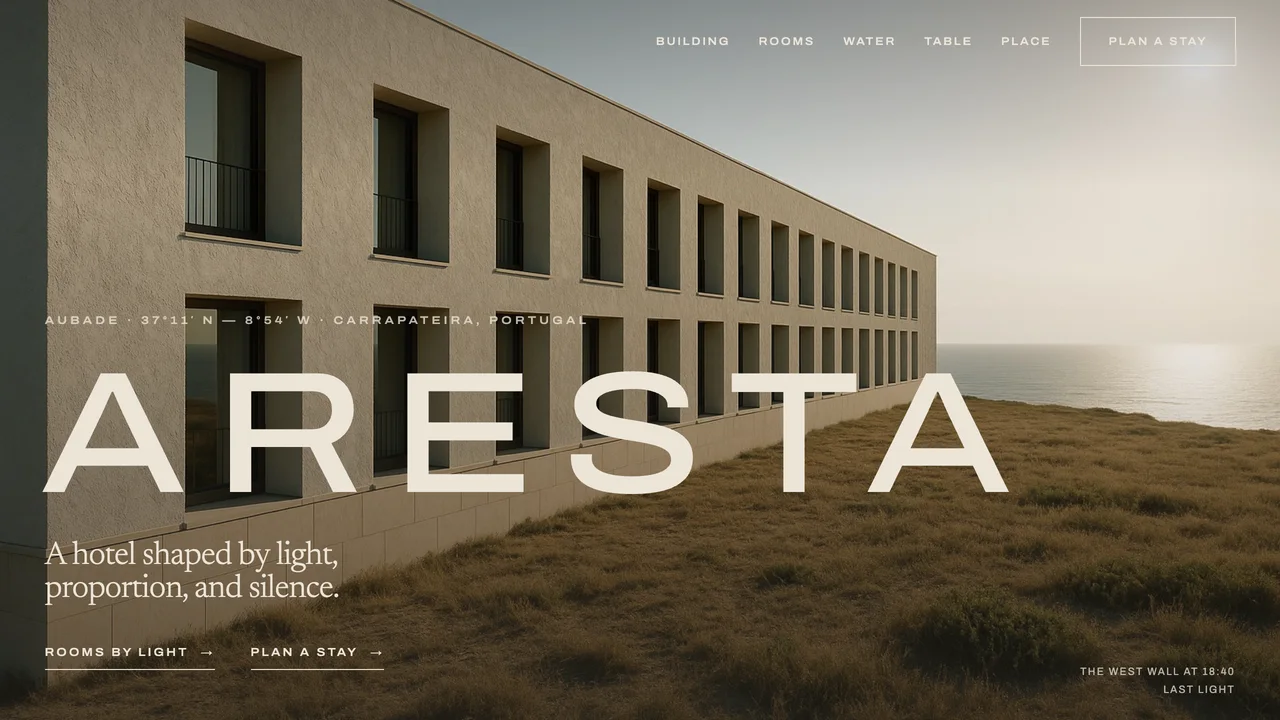
Aresta
A hotel shaped by light, proportion, and silence.
Aresta is a thirty-eight-room hotel on the last plateau above the Atlantic at Carrapateira. The experience translates the building’s governing geometry—bay, reveal, orientation, and hour—into a product system that helps guests choose how they want to inhabit the light.
The premise
The room is not a tier. It is a direction.
Most hotel taxonomies turn rooms into a ladder of size, amenity, and price. Aresta removes that hierarchy. Every room occupies two structural bays; what changes is its relationship to the sun.
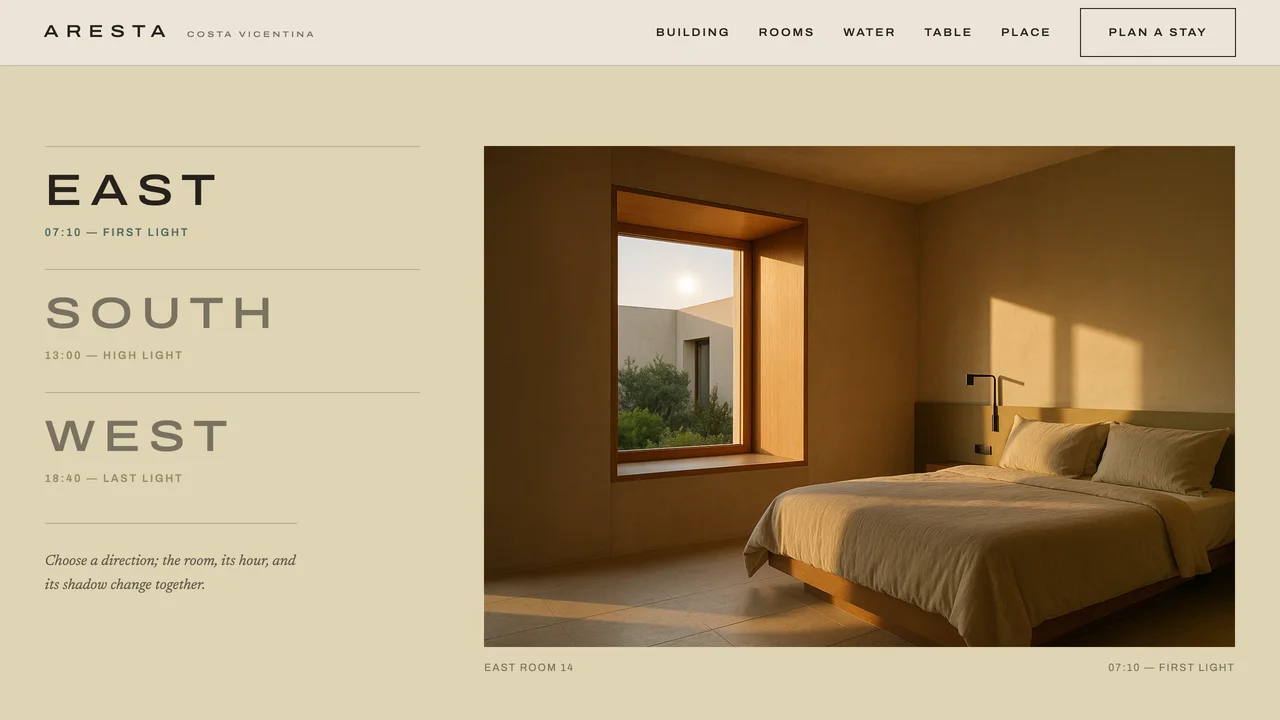
East receives first light, south holds high light, and west receives the final two hours over the Atlantic. The interface makes that architectural difference useful before a guest ever enters the building.
Product principles
The world becomes a working system.
Orientation replaces status
East, south, and west describe a real spatial condition. Guests choose an hour and outlook rather than decoding invented room tiers.
Make the module visible
The 3.6-metre bay and 90-centimetre reveal organize the facade, page grid, image planes, room facts, and caption rhythm.
Describe what light does
Copy names direction, hour, duration, temperature, and shadow. Precision creates atmosphere without luxury language.
Use the coast as evidence
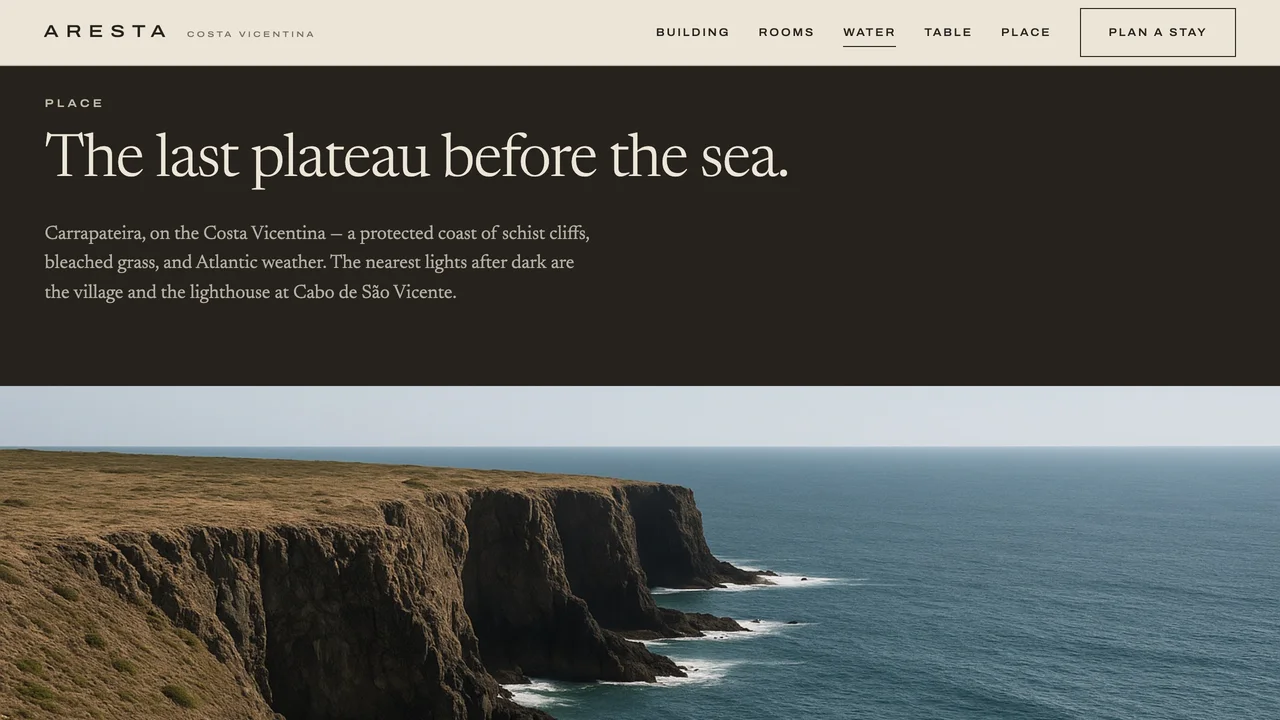
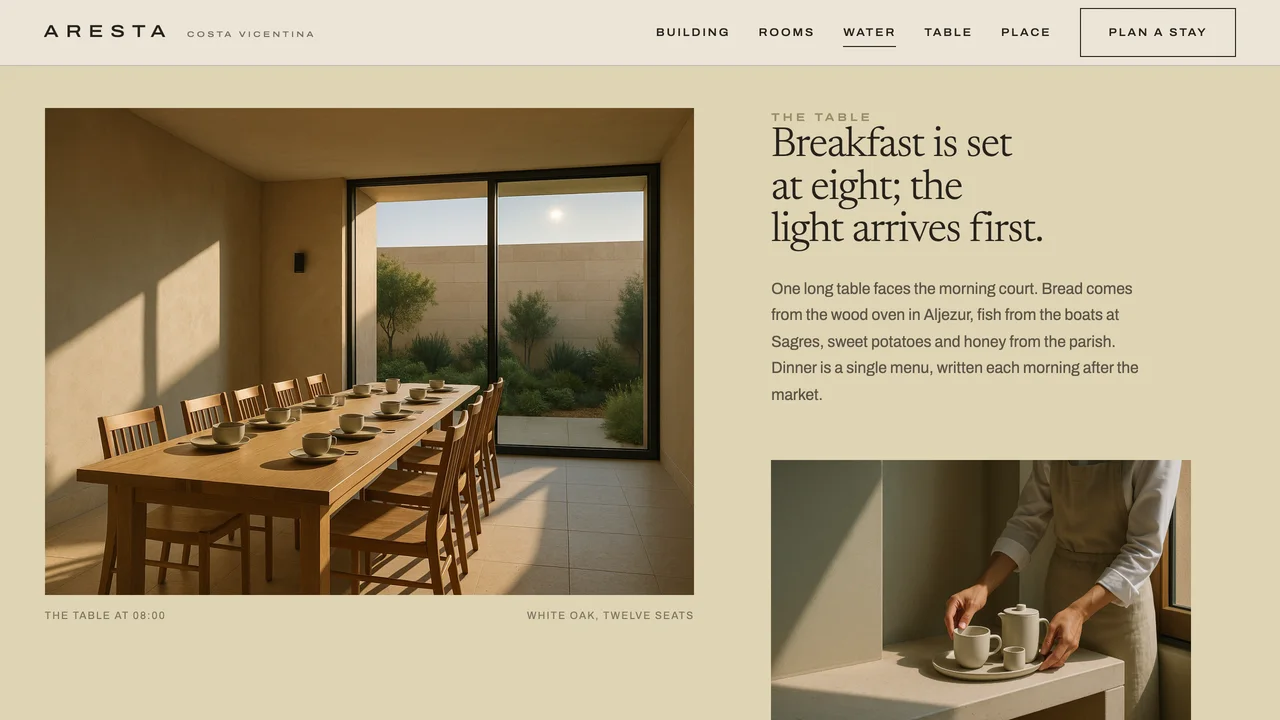
Schist, bleached grass, Atlantic weather, mineral plaster, limestone, bronze, oak, and flax keep the world tied to Carrapateira.
Built proof
A concept carried into code.
Worldbuilding · Art direction · Frontend
- Framework
- Astro static site with focused vanilla JavaScript
- Content model
- Orientation-led rooms, building facts, materials, courts, food, water, and place
- Signature interaction
- Selecting east, south, or west changes image, hour, facts, description, and sun-plan together
- Accessibility
- Semantic tabs, keyboard navigation, visible focus, and complete reduced-motion behavior
- Responsive media
- Art-directed sources preserve deep reveals, horizon lines, and architectural proportion
- Motion
- Light-like settling and controlled transitions; no competing ambient effects